Showing posts with label Catholic. Show all posts

September 16, 2013

Classical Catholic Homeschooling, 2013-2014 Lesson Plans

I vowed to be one of those homeschooling parents that didn't let things slide during the summer.

That I would "do school" all year long.

I was going to be Super Teacher in this house, yes sir.

But...I wasn't.

Sitting out on the porch watching my kids ride their bikes was an irresistible attraction.

Watching them run through the sprinklers was irresistible, too.

Then I got started on my new blog project.

Eventually, I just gave up!

The positive side is, now I have an official start to the 2013-2014 homeschool year.

And all of you get a post.

1st Grade Plans


Princess is 6 and in First Grade. With her I'm doing:

History


We actually did the first unit last spring. It is excellent. I am really pleased with their curriculum.


We're just finishing up Unit 2 now. Each one takes about four weeks, depending on how in-depth you choose to go (extra reading, crafts, presentations, etc).

What I personally enjoy about the curriculum is that it covers a broad base of subjects. We're not only learning history; we're also doing geography, literature, language, social studies and religion. 


I purchased the Daily Lesson Plans, which recommend what I should do each day to cover all the material. I don't think I could do this program well without them!

They are a huge time and sanity saver.


The core books for our history program are the New Catholic Picture Bible, Founders of Freedom, and Usborne's Time Traveler.

Most of the other books we use I am able to check out from our local library as needed.

Math


I decided on Math Mammoth because of the excellent reviews and affordability. I also liked that it is mastery-oriented and requires little prep on my part. 

My daughter started the workbook last spring and has taken off with her math skills.

I use beans and an abacus as our manipulatives.

Reading and Language Arts


My daughter is halfway through TOPGTR, but is still resistant to reading. My only real "must do" goal for the end of first grade is to get her reading confidently on her own.

Having only done a few of the lessons out of FLL, I can't comment on how well I like it. One conflict I've already seen is that it has the student memorize many poems and passages throughout the year, while our history curriculum also has similar memorization built in to their program. 

For now we are only doing that which is recommended in Connecting With History. If my daughter appears she can do more, we will add in those from FLL.


I'm excited about these early readers we just received from Seton Press:


Religion


It will be a year before my daughter will officially enter First Communion prep, but this little catechism is so perfect for teaching even little Catholics! 


We've went through the book last year, but I am doing it again this year. As children mature they pick up on more concepts.


The illustrations are a big help in facilitating understanding!

We'll also be reading these frequently:


And my absolute favorite little books (lucky library sale find):


We have a pretty healthy collection of faith-based videos for "Mommy Break Time." These are a few:


My (lofty) goal is to get them to a daily Mass at least once a week as well. It terrifies me, but I know I'll get over it eventually.

Handwriting


We started these last spring, too. They make learning the cursive letters simple, and to me they were the prettiest script.

Some parents choose not to introduce cursive until 2nd grade, or not at all. My own personal preference is that my children do learn to write neatly and beautifully. It's not one of those "must have" skills, especially in today's computer age where everything is done on a keypad -- but I still believe there is value to learning something that is attractive and requires detailed control. 

When to introduce cursive is ultimately dependent on the coordination (and willingness) of the child. My daughter was definitely ready at age 5. My son, who is 4 1/2, will probably not be ready until he is 7.

Supplements


The above forms the core of our first grade curriculum. However, as supplements I am doing the following:

I seriously love the Spectrum workbooks. They are fun for the kids and give me a good benchmark for what they "should" be proficient in by the end of the year (as compared to national standards). 

I use them as a free-time activity. ("Oh you're bored? Here, do this! Yay!") 

I wouldn't recommend them as a stand-alone teaching resource. They're definitely more for reviewing concepts or giving kids extra practice in their studies.


For art and drawing, I rely on library books such as the one pictured above.

I also bought a lot of bottles of inexpensive acrylic paint from the craft & hobby store, and we have painting once a week. I show my children famous paintings and point out the techniques used (my dear friend here who homeschools taught me to do this!), then they paint their own using similar techniques. Or, for example, we look at a book on autumn leaves and their changing colors, talk about why it happens, then they paint their own leaves.

It's very basic and the emphasis is on enjoyment.


I wasn't going to introduce Latin until 3rd grade, but then I found this Prima Latina cd at a garage sale. Geared for the lower grades (1-3), it is a really nice, easy introduction to Latin and prayers such as the Our Father.

I don't have the corresponding workbook, but I don't really know that it's necessary. All the lessons are on the CD and if I need to know how to spell a word, I can just Google it.

(Some reviewers seem put off by the southern accent of the narrator, but honestly I barely noticed -- and I'm about as northern as you get. It only becomes obvious a couple of times, and even then it's not that heavy. So if you're considering this, I encourage you not to bypass it simply on these grounds.)

Our goal is to do this a couple times a week.


I don't do anything specific for social studies aside from what we learn through Connecting With History and the books we read.

But one thing we all enjoy are these short videos about families from other countries. Each video features a rural and urban family from a particular country and describes how they live from the point of view of the child.

We have a lot of interesting discussions afterward about how other people live around the world. It's especially eye-opening for my children, I think, because almost all of the families -- regardless of country of origin -- live in poorer material circumstances than we do in the U.S. It's important to me that my children understand this and see that even though these children rarely have toys, eat very basic and mundane meals, and at times literally have dirt floors...they are happy, energetic and content individuals.


Note: You may have noticed I don't have anything for Science. I am not formally teaching science this year, though I will be checking out science books from the library on a regular basis for us to read and discuss together. I also have a book of scientific experiments, Janice VanCleave's Big Book of Play and Find Out Science Projects, that we will be doing throughout the year.


Kindergarten Plans


My son is 4 1/2 and technically would only be in preschool or "K4." But since I have the luxury of teaching him at his actual skill level, we are doing kindergarten or "K5" work this year. (He is so adept with numbers that I project we'll be moving into 1st grade math this winter.)

Math


This is such a neat math book! The content is solid, and there is Catholic artwork peppered throughout the pages. 

Handwriting


We're still working on pencil-holding skills and so this reusable printing workbook is perfect for my boy. It helps him to practice forming letters and become familiar with the lowercase versions.

There is also connect the dot, which is always fun!

For reading I'll be starting him on The Ordinary Parent's Guide to Teaching Reading soon. He already recognizes several short words and is just starting to show interest in sounding out letters, so it is a good time to begin.

I also have been printing off free worksheets for him from School Sparks. He thinks they are awesome.

Besides the above, there is no other "formal" schooling I'm doing with him. His interests right now are mainly in building Legos and Snap Circuits, which is fine with me. :)


If you homeschool, what are you doing this year? Feel free to share your blog post here if you have one!

April 2, 2013

Imitating the Pilgrim Witness of Jesus and Pope Francis

"At his last breath the multimillionaire is just as penniless as the dying beggar in a Calcutta street."
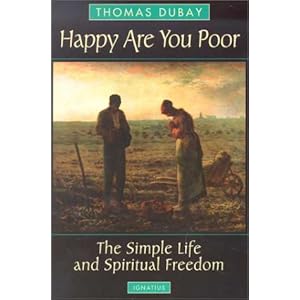
Thomas Dubay, Happy Are You Poor


What the Church desperately needs today is for its followers to give authentic witness to the truths of the Gospel. Over Lent, we were profoundly blessed by God to be given another simple, loving man with deep personal holiness to help us as our Papa: Pope Francis. His namesake, St. Francis of Assisi, being one of the most remarkable Christian men of all time -- remembered for his love, purity, peace, and of course, poverty.


By all accounts Pope Francis embodies what it means to walk in the spirit of evangelical poverty that Jesus calls His followers to embrace, that Francis of Assisi lived, and that Thomas Dubay outlines in his book, Happy Are You Poor. Catholics all over the world are thrilled with his simplicity and embrace of only the bare minimum to sustain himself and do his job. I, too, am so very encouraged and enlivened by his example! I eagerly look forward to all that God will say and do through him.

But -- and I have no doubt Pope Francis would agree -- our admiration is not useful unless we, too, follow his example in our daily lives. It is imperative for us as professing Catholic Christians not simply to stop at lauding the humility of a Pope, declaring what a great message he is giving to the Church at large, and hoping that more bishops and priests follow his example. Those sentiments are understandable, yes! But after we have done those things, we must go take the next step. We must pause to consider what Jesus Christ is saying to us personally through this man we consider our appointed shepherd and spiritual father. Can we in good conscience nod our heads in approval, call for others within the Church to imitate him, and then continue to spend large sums of our own money (or money we don't even have!) on acquiring fancier homes and cars, the latest in fashionable home decor, the newest electronics, artificial tans and wrinkle creams, toys/gear/supplies for our numerous hobbies, and the like?

Dubay's chapter entitled Pilgrim Witness opens up with this:
"There is much in Scripture to which a theist has little difficulty in giving theoretical assent but to which in concrete daily life he grants almost no assent at all. No convinced theist has any problem in admitting that idle talk is reprehensible for several reasons, one of which is that it impedes the biblical call to continual prayer. But in daily living few give any thought at all to the problem of continual chatter and the account we are to render of it on Judgement Day (Mt. 12:36). 
Most of us have heard over and over in liturgical readings the admonition of Jesus that we must give up all that we possess to be his disciples (Lk. 14:33), but few in the humdrum of the day-by-day round even advert to detachment, let alone practice it with any approximation of totality." [p. 81]
We have a particular problem here in the United States with the dominant value of our culture being economic: "the American dream" and "the good life" being two popular phrases where obtaining wealth and the indiscriminate spending of that wealth is the unsaid principle. For the Christian this should pose a serious dilemma, as this ideology flies in the face of the entire Gospel ideal. But the value of the economic "good life" is so pervasive that the ordinary American Christian has become utterly desensitized to Jesus' call to "give up all that we possess." We have been lulled to sleep -- by our education system, the media, our peers, sadly even our own family members and churches -- and we've convincingly assured ourselves that we can arrange our lives around the things of the world (possessions and pleasure seeking) and yet still have all the treasures of heaven added on to us as well.

Dubay relates a specific excellent example about how the underlying economic ideal forms our decisions as Christians:
At Mass one Sunday  morning in October a serious, deeply religious couple hear that the following week there is going to be a collection for the foreign missions. As they drive home Mrs. Jones is likely to say, "Bill, do you think we could afford something like $20 or $30 for this collection?" After some musing Mr. Jones may well respond that he, too, thinks they could afford that amount as their contribution. While most would indeed consider Mr. and Mrs. Jones a generous couple, we must note something significant. When both of them used the expression "we could afford", they meant "without changing significantly our level of consuming." They did not mean "we could afford $20 or $30 if we dine out less frequently or give up smoking and cocktails, or if we cancel our vacation trip, or sell one of our sports cars." 
Even in serious people the good life ideology is operative, and it profoundly influences what they do and do not do on the operational level. If Mr. and Mrs. Jones were to give up the good life ideal, they could give far more to the foreign missions. [p. 84]
Ethicist Richard McCormick wrote something similar: "It can be argued that the single dominating and organizing value in American culture is economic... This means that other values will be pursued and promoted only within this overriding priority. Thus, justice in education, housing, medical services, job opportunity is promoted within the dominance of the financial criterion -- 'if we can afford it', where 'afford' refers to the retention of a high level of consumership."

As Christians we are told plainly that we're merely pilgrims in this world (1 Peter 2:11, Heb 11:13-16), but we rarely live as if that's our reality. "We assume that we belong here, that this is our fatherland, that our security is enhanced by a higher salary, a paid-up mortgage, and adequate coverage by insurance," writes Dubay. We need to rediscover the great freedom and joy that we are offered in Christ when we arrange our daily living like pilgrims! We need it not only for our own souls, but for the sake of the conversion of the world -- a world that desperately needs and even desires to discover authentic pilgrim witnesses.

Dubay said in his book that the world and those of us in the world need "lived prophecy." Indeed. The lived prophecy has to be spoken through each of us, whatever our state in life, not just through our dear Pope, our parish priest, and some monks and nuns living in the cloister.

Before Cardinal Jorge Bergoglio became Pope Francis he gave an interview where he spoke on some very relevant points pertaining to this consumerist idolatry that threatens so many of us in our quest for God. I want to end with a few of his quotes (and please, listen to the entire interview -- it's fantastic):


"In today's society new idols are continuously established and driven by consumerism... There is where people get hooked. Indeed there is a strong need to renew the faith."

"Only Jesus provides the answer to this rampant idolatry. And he reigns from the Cross. If we deny the Cross of Jesus, we deny Jesus."

"An interesting fact is the amount spent on non-necessities world wide... On those things that are not necessities, or superfluous things, the greatest amount is spent on pets. The most unnecessary spending is made on pets. Pets are idolized... And the second largest amount of money is spent on cosmetology. Cosmetics. ...There are millions and millions spent on these two things. Meanwhile the Pope is talking about children who are dying of hunger in underdeveloped continents like Africa, Asia and America. First come pets. And then if there is something left, we throw it to the children."

"If you don't worship God, you will have something else. I don't know which one: A pet. Cosmetics. I don't know."

(Last year in the United States alone, over $53 billion was spent on pets and at least $33 billion on cosmetics.)


This post is part of a continuing series of posts on the book Happy Are You Poor. Go here for the first post of the series!


February 5, 2013

A Sparing-Sharing Lifestyle


In this continuing series I last touched on the underlying point of living a factually "frugal" or "poor" lifestyle (what the author frequently refers to as Gospel poverty). This entry will be relatively brief, as I'm only going to give some highlights from the chapter "A Sparing-Sharing Lifestyle." I encourage you to get a copy for yourself because Thomas Dubay makes so many wonderful points that I couldn't possibly relate them all here!

"Biblical writers were not philosophers, but they knew well enough that material sharing is a consequence of any sincere love. If the goods of earth are extensions of my person and if I love my neighbor as myself, I naturally share my good things. It is idle for me to proclaim concern for the poor, the homeless, for example, and at the same time indulge in elegant dining and drinking, pleasure traveling, and an extensive wardrobe. My life belies my rhetoric... If I am to love my fellowman as myself, it must follow that I desire that his needs be cared for at least as well as I care for mine." [p. 65]

Blessed Mother Teresa

"The contemporary teaching Church has made the point more than once that it is not enough to give of our superfluities to the needy of our world. We are to give even from our need." [p. 67]

"A sharing manner of life is not optional. Creation belongs to all members of the human race, not mainly to the clever, intelligent, resourceful, well born. Sheer justice demands equitable participation. Pope Paul VI cited Saint Ambrose when he said, 'You are not making a gift of your possessions to the poor person. You are handing over to him what is his. For what has been given in common for the use of all you have arrogated to yourself. The world is given to all and not only to the rich.'" [p. 68]

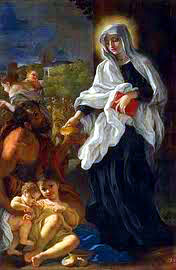
St. Louis, King of France, serving the poor

 "A word of caution. In all our enthusiasm for the alleviation of the plight of the poor we are well advised to avoid the basic atheistic thesis that material destitution is the greatest of all evils... Social injustice is evil, no doubt. But there is a far greater evil, namely, that of not seeking God... They of the largest minds, the saints, have lived heroically the sparing-sharing life of the Gospels, while at the same time they first of all sought eternal life both for themselves and for others." [p. 68-69]

"Some, like Saint John the Baptist de la Salle, lived the message of this volume in a simple direct manner: they literally sold all they owned and gave the proceeds to the poor. Others responded to the Gospel after the manner of Blessed Louisa Albertoni, who, after her husband died, lived in deepest personal poverty and prayer. This woman expended her entire fortune in behalf of the needy to the point that she had nothing left, and she herself lived on alms. Louisa had a unique way of getting rid of her wealth. She would bake huge batches of bread, put gold and silver coins in the loaves, and then distribute them to the poor." [p. 69]

Blessed Louisa Albertoni

"While he was still a layman Saint Peter Damian not only gave directly to the needy but also often invited them to his own table and served them with his own hands. Saint Paulinus of Nola and his wife used their wealth for sundry religious and philanthropic exercises, but they also supported a large number of poor debtors, itinerants, and other needy people. Many of these they lodged in the lower section of their own house." [p. 69]

"Austere and hard on themselves, the saints are customarily indulgent and even tender with the ill and unfortunate. Saint Paschal Baylon, who as a layman went barefooted, ate meagerly and fasted often, yet went to the trouble of obtaining delicacies for the sick and needy. Saint Teresa of Avila mentioned in one of her letters that she commonly gave away to others the candies and other niceties she received." [p.71-72]

February 4, 2013

The Point of Choosing Poverty


Thus far in this book series I've shared briefly about who is intended to embrace evangelical poverty, as well as what Gospel poverty is not. Thomas Dubay's sixth chapter in Happy Are You Poor: The Simple Life and Spiritual Freedom is titled "Emptiness and Radical Readiness" -- but I think it could be best summed up as "What is the point?"

 It's a valid question. Yes, the Scriptures are undeniably clear in their "hard sayings about the incompatibility of riches and the kingdom." Over and over again we read that,
"it is easier for a camel to pass through a needle's eye than for a rich man to enter God's kingdom (Mk 10:25 and parallels)... The rich man who does not share with the beggar Lazarus at his gate ends up in hell, for he had his comfort in this life (Lk 16:19-31). No one can serve two masters; he must take his pick: God or money; he cannot have both (Mt 6:24). The word of God is smothered, choked, and does not reach maturity in people who succumb to cares, pleasures, and wealth (Lk 8:14 and parallels). We are to avoid avarice in all its forms, for there is no security in finite things even when we have an abundance of them (Lk 12:15). "Woe to the wealthy" is Jesus' proclamation to the rich, for they have their consolation now (Lk 6:24). We are not to lay up treasures on earth where moths and rust corrode and thieves steal...(Mt 6:19-21)." [p. 55]
But while the proclamation to live a different way of life than human reason dictates is obvious, sometimes the understanding of why is not so clear to us. Dubay observes that, "Sensible people do not choose emptiness for the sake of emptiness. Of itself negation has no value... The value of negative things derives, must derive, from something positive, something they make possible."

Therefore we can reasonably conclude that embracing Gospel/evangelical/factual poverty, itself a mere negation or not having, actually is so highly commended in the Bible because of what it makes possible

The primary thing factual poverty makes possible is a readiness for the kingdom.
"Factual poverty embraced in faith does something to a person in the deep resources of his being. It matures him, develops him, makes him receptive to what the Lord Jesus is about... One who is poor in and for the Lord is concretely affected by the Gospel... It brings about a felt sensitivity to what the Lord Jesus is all about. It helps dissolve opaqueness, dullness, resistance to the word of God." [p. 56-57]
It goes without even saying (though I will say it anyway because I think it is that important) that the values of God and the values of the world are very much radically opposed. Everything the world esteems and persuades us to chase is 180 degrees removed from that which God cherishes and finds delightful. Most of us, somehow, have had our souls calloused by the bombardment of mainstream media and entertainment, worldly friends and coworkers, and at times even the influence of our own family.

As Dubay points out, one not even go further than an innocent reading of the morning newspaper in order to find the messages that are so alien to Christianity. We all know them (and perhaps have even fallen victim to them, assuming they are compatible with our love of God):
"Prestige is a primary value...bodily comfort and pleasure are indispensable...this life is all we have, so let's enjoy it to the full...impressing people with one's possessions and accomplishments and attractiveness is important...sexual excitement and satisfaction are crucial...success is "coming out on top" in relation to to others...money is a must, for without it one can have very little of anything else worth having in life." [p. 57]

Just take a moment to compare these premises to those found in the New Testament:
"Humility, being last, unknown, hidden in Christ, is a condition for getting into the kingdom...prestige is worthless and even an obstacle to greatness...the hard road and the narrow gate, carrying the cross every day is immensely important...dying to our selfishness and crucifying our illusory desires are indispensable...impressing people is of no importance at all, whereas being pleasing to the divine eyes is everything...virginity is a favored and privileged state, and chaste fidelity in marriage mirrors the very union of Christ and his Church...one may not try to best others; rather he is to serve them as though he were a slave...it is most difficult, indeed it is humanly impossible, for the wealthy to enter the kingdom of heaven." [p. 57-58]
The difference is remarkable! And so it is not difficult to see, then, that the majority of us  -- weakened by our concupiscence and having to live within the world to obtain an education, conduct business, and/or raise our families -- are not always going to be readily disposed to the things of God. Some of us have more receptivity and readiness than others (see the Parable of the Sower), but the fact remains that there is still work to be done to till the soil in us that makes us inhospitable to God's seeds of truth. Gospel poverty does that for us.

I love when Dubay demonstrates the necessity of detachment from material possessions in order to be truly free to love God. He says that, "for us wounded human beings, possessing imperceptibly slips into being possessed. No sooner do I have a watch of some quality than I begin to be reluctant to part with it even if someone needs it more than I do." This is dangerously accurate, is it not? We purchase a brand new, top of the line TV, or that cute scarf we've had our eye on over at Etsy, and in a very real sense we begin morphing into Gollum from the Lord of the Rings. Our objects become our "precious" and we aren't even willing to entertain the possibility of giving them away and doing without -- much less with a cheerful, generous and peaceful attitude! It's not until the next eagerly desired possession comes along -- one that is no doubt newer and lovelier -- that we become willing to part with it.


Dubay continues, "This means that it, a mere thing, has taken a hold on my heart. Having wealth is damaging to the pursuit of the kingdom because the very having does something to one's inner life, one's very ability to love God for his own goodness and others in and for him."

The "very having" he talks about is a deceptive and insidious disease that can quickly and efficiently lead to our damnation. The reason Jesus made the point that it is easier for a camel to enter the eye of a needle than a rich man to enter heaven is that the person with wealth is literally "blinded by his clingings. He not only does not do what he ought to do with his wealth, he does not even see what he ought to do. To him it is obvious that his barns bursting with crops are to be used for his own pleasure: eat, drink, make merry, take things easy (Lk 12:16-21). It does not occur to him that this abundance should be shared with the downtrodden."

Jesus Christ has made clear that the only remedy for the blindness is a casting off our superfluous goods; we must embrace the evangelical notion of poverty described to us in the Bible and demonstrated to us via the lives of the Saints.

You will not find this message from mainstream sources. Even popular Christian-based financial gurus are not reliable sources of advice for biblical living. Take for instance the highly-acclaimed message of Dave Ramsey, whose plan to get out of debt has been immensely helpful to my husband and I. Many of his recommendations are excellent, particularly in helping people arrange their spending in a way that gets them out of debt and helps them stay out of debt. However, on the other hand, the totality of his message and his example is definitely not one of Gospel poverty.


We as Christians are nowhere advised to have the goal of accumulating wealth, living like "no one else" (aka: sacrificially) so that later we can "live like no one else" (aka: grandly). Neither is it ever indicated that we should have the goal of accumulating wealth in order to give to -- or, to use modern church speak -- "bless" others. You will not find one Saint in the record books that operated by this standard -- in fact, just the opposite is true. They did not work toward becoming wealthy; rather, they took whatever wealth they had and distributed it to others so that they themselves subsisted on very little.

This is true even of those devout men and women who lived in the world and were not professed religious who had taken a vow of poverty. They wisely provided for their family until a time came where they could renounce material goods fully, with provision indicating food, shelter, clothing, basic household goods and - if able - quality spiritual books and education. (In modern terms, provision does NOT mean giving children elaborately decorated rooms filled with expensive diversions while mom and dad work towards a fancier home, sportier cars, lovelier furniture, newer "toys," bigger wardrobes, elegant food, superfluous entertainments, or pampered vacations.)

The example of the Saints' piety is not for us to praise but then claim impossible for ourselves. We are ALL expected to make our entire life "the sacrifice" -- the time to "play" will come in the next life, where riches and possessions will be obsolete and we'll find our indescribable, glorious pleasure in one thing alone: the Lord our God.

If we don't have the sensitivity to see the exquisite treasure of this eternal destiny, we should examine ourselves: has our desire for pleasure in this life dulled, or, God forbid, replaced our desire for Jesus Christ?


January 29, 2013

What Gospel Poverty is NOT


Continuing with my reading of Thomas Dubay's book Happy Are You Poor: The Simple Life and Spiritual Freedom, I wanted to touch on his chapter about what does not characterize Gospel poverty. He makes nine points (quotes are directly from the book):

1. Filth, carelessness, laziness, disorder
Living in squalor with counters full of last week's dirty dishes and old, broken items littered about the yard is not living the Gospel poverty ideal. "From seeing in the mass media so frequently the coexistence of filth and poverty, we easily infer an inner connection between them. There is no basis in the New Testament for this connection."
2.  Destitution
Rather than compel us to live without the very basic necessities (clothing, food, shelter), the Gospel teaches us to attempt to "rub it out wherever it exists." We can live the Gospel poverty ideal without being utterly destitute ourselves. (Although there are some people who will be called to embrace such a lifestyle, such as St. Benedict Joseph Labre.)
3. Miserliness
Avarice is a sin, not a virtue. The goal here is not to be a Mr. Scrooge, but one who has no love of money so that we can freely part with it in order to benefit others.
4. Being economical
Carefully using money and material goods is good, but it is not automatically synonymous with Gospel poverty. "One who is living the New Testament teaching will usually be economical in his use of creation, but it may possibly happen that what is more economical in a given case may be less in accord with Gospel poverty. An expensive, heavy car may last as long as two small ones, and thus be more 'economical,' but it does not follow that people with a vow of poverty ought to buy the former."
5. Being (merely) detached
Anyone truly striving to live the Christian life should have as their goal a true detachment from money and material things, for without it we cannot wholly love God and neighbor. However, the Scriptures indicate that a spirit of poverty alone is not sufficient; "more is needed before we have satisfied the demands of the Lord Jesus."
6. Availability of person, talent, time
In modern times some have tried to argue that a person is living Gospel poverty when they give themselves in some sort of volunteer fashion. Serving at every weekend Mass as a lector or teaching Sunday School classes are most certainly positive endeavors, however they are not substitutes for a frugal, 'sparing-sharing' lifestyle. "A mere reading of the New Testament rapidly shows that when revelation speaks of poverty, it is speaking of material goods, not personal availability."
7. Insensitivity to health
"Scripture nowhere advises us to be careless regarding health. True enough, there is no support either for pampering one's body. We are to carry our cross daily, but this does not imply that we abuse the health God has given us. Even the Lord himself requires the disciples get rest when they need it after laborious work."
8. Respectful use of creation
"No one questions that we should use the earth's resources soberly and respectfully," but can we honestly conclude that the Gospel ideal of poverty is "adequately met" simply by adhering to this highly subjective maxim? "The most selfish people can easily convince themselves that their use is 'sober and respectful.'" Clearly Gospel poverty is much more than an environmental awareness and use issue.
9. Amorphous sentimentalism
"Wealthy societies do not lack people who can speak eloquently about the third and fourth worlds, who call emphatically for 'consciousness raising' about the dire destitution among vast populations and yet who seem to see no incompatibility between their speech and their own way of life. They live comfortably, sometimes elegantly. They possess extensive wardrobes, enjoy costly vacations and recreations and dining and drinking and traveling. And yet they talk of the value of Gospel poverty. Their rhetoric of course impresses few listeners...
Talking about the needy and yet not sharing with them betrays a dead faith and an absence of love. Beatification and canonization processes make plain what the Church thinks of laymen and clerics and religious who live comfortable lives with scarcely a thought for the have-nots in our world."

January 24, 2013

Persevering in prayer

In Fr. John Bartunek's book The Better Part: A Christ-Centered Resource for Personal Prayer I encountered such a profound reflection that I was moved to share it in hopes it inspires somebody else also:

26 And when they had sung a hymn, they went out to the Mount of Olives. 27 And Jesus said to them, "You will all fall away; for it is written, 'I will strike the shepherd, and the sheep will be scattered.' 28 But after I am raised up, I will go before you to Galilee." 29 Peter said to him, "Even though they all fall away, I will not." 30 And Jesus said to him, "Truly, I say to you, this very night, before the cock crows twice, you will deny me three times." 31 But he said vehemently, "If I must die with you, I will not deny you." And they all said the same.
32 And they went to a place which was called Gethsem'ane; and he said to his disciples, "Sit here, while I pray." 33 And he took with him Peter and James and John, and began to be greatly distressed and troubled. 34 And he said to them, "My soul is very sorrowful, even to death; remain here, and watch." 35 And going a little farther, he fell on the ground and prayed that, if it were possible, the hour might pass from him. 36 And he said, "Abba, Father, all things are possible to thee; remove this cup from me; yet not what I will, but what thou wilt." 37 And he came and found them sleeping, and he said to Peter, "Simon, are you asleep? Could you not watch one hour? 38 Watch and pray that you may not enter into temptation; the spirit indeed is willing, but the flesh is weak." 39 And again he went away and prayed, saying the same words. 40 And again he came and found them sleeping, for their eyes were very heavy; and they did not know what to answer him. 41 And he came the third time, and said to them, "Are you still sleeping and taking your rest? It is enough; the hour has come; the Son of man is betrayed into the hands of sinners. 42 Rise, let us be going; see, my betrayer is at hand." [Mark 14]
 Jesus went off to pray in order to align his tormented will with the Father's will. He didn't pretend that what God was asking him was easy -- it wasn't. But he wants to be faithful. Just wishing for fidelity, however, is not enough; fidelity has to be won by persistent prayer. St. Mark tells us that Jesus went off to pray, came back to his disciples, and then went off to pray again. He did that three times. Three times in the course of an hour or more, Jesus literally threw himself on the ground in order to wrest grace from the Father to bolster his flagging human nature.

The lesson couldn't be clearer: fidelity to our mission in life takes perseverance in prayer. Jesus suffered unspeakable fear, distress, and sorrow as the guilt of human sin slowly seeped into his soul and the shadow of the cross darkened his mind. He experienced this Gethsemane for us: to atone for our sins, but also to blaze a trail that we could follow through our own Gethsemane. We each have them. Christ's passion, death, and resurrection -- the Paschal Mystery -- is the pattern of each Christian life. If we are to abide in God's will and accomplish our mission in life, we too much develop sincerity and persistence in our life of prayer.

Everyone's Gethsemane is tailor-made, but the secret to endurance is always the same: persevering in prayer. The spirit is willing, but the flesh -- our fallen human nature with its tendencies to comfort and self-centeredness -- is weak; it needs the constant nourishment and strengthening that comes from contact with God.


January 22, 2013

Happy Are You...Poor?


And he, lifting up his eyes on his disciples, said: 
Blessed are ye poor, for yours is the kingdom of God. 
Luke 6:20

If there's anything so starkly opposite of the American dream, it must be the idea of Gospel poverty. In Thomas Dubay's book Happy Are You Poor: The Simple Life and Spiritual Freedom he opens with a frank acknowledgement of the situation:
"To the unprepared eyes of modern men and women the title of this book can hardly be taken seriously. To suggest that poverty is desirable seems to approach absurdity. To imply that it is somehow meant for all people in every vocation may seem outrageous." [p. 11]
Reading this book when I first bought it several years ago, I myself had great difficulty imagining myself taking on the "sparing-sharing," frugal ideal Fr. Dubay speaks about. It wasn't that the Scriptures weren't replete with examples advocating for this very thing (they certainly are) or that his arguments weren't sufficiently persuasive (his handling of the subject is precise and compelling). No, the problem really came down to this: my soul wasn't sufficiently converted.

To consider detaching myself from my quest to acquire unnecessary possessions and enjoy spendy pursuits -- makeup, home decor trinkets, the newest smart phone, regular dining in restaurants -- was too much to ask. Though what I read was convicting and a part of me longed to make a real change to my life, it wasn't long after I put the book down that I began the inner argument that surely I could be a good and devout Christian while still enjoying my material indulgences and comfortable lifestyle. After all, I reasoned, I was relatively poor compared to many people I knew. God surely would be OK with my mode of living as long as I was refraining from serious sin, participating in Mass and church life, and dropping some of our money into the contribution basket each Sunday. That was "good enough"...it had to be. Right?

Now before I go further, let me clear that my purpose here is not to convince anyone on the validity of the Gospel poverty ideal. That's what wise and deeply pious folks like the author of this particular book have done already (Fr. Dubay passed away shortly after I purchased his book, may his soul rest in peace). I just want to share some of my favorite parts of the book and what has most touched me personally now that I've re-read the book from a much different state of mind and soul. :)

I've found that as my soul has been drawn closer to God, He has converted much of my way of thinking. As Fr. Dubay even mentions, "The only way to know the perfect will of God is to undergo conversion from the worldly outlook. The sensual person cannot understand the things of the Spirit; it is nonsense to him. Unless one is attempting to lead a serious prayer life, he is not likely to be much affected by the message in these pages." Recently I started re-evaluating just what level of sacrifice God was calling me to (in many areas), and as part of that process I picked up this book again. I was humbled to realize that my previous concessions on my lifestyle were indeed just that: concessions. In prayer God impressed on me that my idea of "good enough" is a lukewarm state indicating I was content with being merely mediocre in my relationship with Him. Out of love, He desires more from me. And out of love, I am moved to respond.

But just who is intended to live this Gospel poverty? The term probably brings to mind a dozen different definitions depending on who you ask, and the idea of who should practice it is probably as equally debatable.
"When most people think of poverty, they think of destitution. They envision squalor, malnutrition, ragged clothing, dire housing, omnipresent dirt, the absence of necessities for decent human life. Whatever gospel poverty might mean, they do not take seriously the thought that destitution is a viable option for themselves." [p. 11]
 Others, who perhaps have done more reading, do not equate poverty with destitution. However,
"...knowing that it does not mean destitution, they turn their thoughts in the direction of religious life. They have heard of a vow of poverty, and, feeling no call to vowed life, they dismiss the thought of it quite as readily as the thought of destitution. Obviously a married person cannot seriously entertain either choice as compatible with the roles of responsible spouse and parent." [p. 11]
The author argues, and with the support of a myriad of reputable New Testament scholars, that poverty in the sense that the Scriptures talk about is meant for all -- not just the desert hermit, not just the St. Francis of Assisi, not just the parish priest, but for the college student, young wife, father of five and businessman, and grandparent.
"In the liturgy throughout the year, weekdays and Sundays alike, one hears over and over again that the poor are blessed, that we must renounce all that we possess to be a disciple of Christ, that if a person has two tunics and a needy brother has none he must give one away, that it is easier for a camel to pass through the eye of a needle than for a rich man to enter heaven, that we came into the world with nothing and shall leave it with nothing and therefore we ought to be content with food and clothing and gladly give up superfluities... States in life vary in the efficiency with which they lead to the goal, but the goal remains the same for all. The laymen's living of frugality must differ in some ways from that of the religious and cleric. But the difference is not that between mediocrity and excellence. Evangelical poverty is radical, and it is radical for all." [p. 12, 13]
I agree, and so I am moved to consider just what it means (and what it doesn't mean) to live this sort of frugality. In my following posts I will go further into the book and share what stood out to me.


January 21, 2013

Going Forward

After a lengthy period of reflection, I've decided to take a definitively different path with this blog. While this site has been largely domestic in nature, from here forward I'm going to be focusing primarily on my Catholic faith, reflections on the love of God, stories about the Saints, inspiring quotes, and so forth. That is not the say the domestic aspect will not remain -- I'm sure it will! But it will look quite different than it has thus far.

I've come to the conclusion that my posts will be necessarily brief due to the nature of my daily life, which leaves little time for lengthy discourse. Whether it's due to motherhood or age (or both!), I have difficulty even composing a coherent sentence most days. :) Nevertheless, it is my prayer that what I am able to share will be encouraging and/or thought-provoking for many of you out there that are striving to grow in love and holiness in the Lord. Over the last couple of months I have come to a strong sense that everything else I could possibly offer (recipes, cleaning tips, etc.) is vanity next to that which pertains to Christ Jesus. Useful? Of course. But secondary all the same.

I am going to begin by sharing excerpts and thoughts over the coming days/weeks about an excellent, if not deeply challenging, book I recently read for the second time: Happy Are You Poor: The Simple Life and Spiritual Freedom by Fr. Thomas Dubay.

 I hope you will join me. :)

December 3, 2012

DIY Advent Calendar


Advent is upon us. Happily, this year I was prepared BEFORE the first Advent Sunday. (It only took three years as a Catholic to get it together...)

Usually I buy those classic window-box calendars filled with chocolates, but I couldn't find them in town this year. So, I did the Pinterest Mom thing and, after seeing everyone else's ingenious creations, cobbled together my own calendar. (What did our moms do without Pinterest, I wonder?)


This is really easy to do, so if you haven't purchased or made a calendar for Advent yet...don't despair. I've been there. ;) If you are crafty you'll probably have all of the necessary items stashed throughout your house somewhere, but if not, they are cheap and easy to find.

To make this calendar, simply hang up ribbon (or twine) using push pins or nails, then use clothespins to clip on mini chocolate bars and scrapbook paper labeled with numbers.


Tada!

Next year, if I'm even MORE prepared, I will write some Scripture verses on the back and throw in a few "surprises" like family movie night.

One thing at a time, though. ;)


November 26, 2012

Worthy Reads This Week


My blogging presence has been greatly minimized this past week due to Thanksgiving celebrations (good thing) and a family flu bug (bad thing), so my usual weekend Worthy Reads got pushed back to today. As we recover (pray for us!), please look elsewhere...like the links below. ;)

Witnessing in the Here and Now by Genevieve Kineke @ Catholic Lane
Is it possible that when many important virtues ran hand in hand with the popular culture, that people lost their sense of Christ, who is the measure of all things? Could it be that convention was embraced as a way of creating order and stability rather than as a means of acknowledging our need for constant renewal? Is it possible that Christian piety had become ossified and stale?

The recent election made clear that those human constructs—Christian or otherwise—are no longer welcome in this individualistic paradise. Human dignity, the sanctity of life, marital fidelity, and many normal expressions of virtue are scorned as anachronistic by those who have “run too far ahead.”

Is there anything positive in this? How can good come of it? First, it purifies our intentions—we must now do the right thing for the right reason, which is what mature Christians do. 
Keep reading...

St. Christina the Astonishing and the Holiday Stinkiness by Stacy Trasancos @ The American Catholic
 Alright, let’s face it. Is this the time of year, just after Thanksgiving, when you start dreading the impending “Holiday (Don’t call it Christmas) Season?” You know, the season of nightly news stories about how schools won’t allow the display of Christian symbols, the already beginning onslaught of commercialism and advertising, the atheist sloganeering that degrades an event so sacred, and all the politically correct puffery about how to speak of the Holy Celebration of The Birthday – Christ’s Mass – without actually saying it.

It’s almost intolerable and almost ruinous, like the odor of the hydro-treated petroleum distillates of Goo Gone® invading a warm and apple-cinnamony glowing kitchen. Pee-yew!

How to rise above it all? Well, there’s a unique, if not peculiar, saint who would probably react the way I’d like to react in the middle of holiday nonsense, St. Christina of LiĆ©ge, also more appropriately named, St. Christina the Astonishing. She frequently tried to escape, well, worldly stinkiness.

Keep reading...

Becoming a Holy Family by Terry McDermott @ Catholic Lane
“How many of you say prayers with your family before bedtime?” Of the twenty children in the class, only two put up their hands.

“How many of you say the Grace Before Meals?” No show of hands.

“Do you ever pray the Rosary with your family?” Again, no hands.

“Who goes to church every Sunday?” This question was met with a greater show of hands, but it wasn’t unanimous.

It’s no surprise that our society is becoming increasingly secular. The God of Truth, in large part, has been replaced by the gods of convenience, acquisition, power, prestige, sex. The Lord’s Day has become one more day in which to shop and family time has been replaced with overly-scheduled children’s sports practices and music lessons, as well as parents’ pursuit of self-actualization. Is it any wonder that so few of the children in my class have any time for prayer at all?

Keep reading...

Love Can Be Hated by Leticia @ Catholic Sistas
Real love is hard. Real love hurts. Real love is a mess. And real love means putting ourselves on a cross freely for the one(s) that we love. 
Everything Jesus did from the moment he was conceived in Mary’s womb to the moment He ascended into Heaven was Love Incarnate. Everything He did was to show us the way of Love, the way of God; the Way to Heaven. He was God and He was born in a barn and laid in a feeding trough. He came down from Heaven and put Himself right in the middle of our human messiness. There is no place messier than a trough used to put food scraps for the animals. Then He lived a life of a normal person loving, laughing, working, worshipping, crying and meeting person after person who He loved, who He CREATED, and who rejected Him or didn’t recognize Him. He was betrayed, arrested, berated and hung on a Cross. Why? 
To show us what Love is. Who Love is.

Keep reading...

Let's Talk More About Abortion by S.E. Cupp @ New York Daily News
This past weekend, I was down in Washington and had a chance to talk to some Republican lawmakers and strategists on Capitol Hill about the trouncing we took in the presidential election.

Over and over again, the fear that the conservative pro-life position may have contributed to our loss came up. Their solution? We have to stop talking about it.

But this cannot be an option. The respect for life is a moral imperative that defines conservatism as much as fiscal responsibility. Conservatism cannot abandon it and remain uncompromised.

Over time, liberalism has normalized abortion, first insisting it should be “safe, legal and rare,” then painting pro-life advocates as fanatics who should be ostracized for foisting their puritanism on the public.

Conservatives need to reclaim the conversation — which they can’t do without talking about it.

Keep reading...

The 'Catholics Are Divided, Too' Objection by Bryan Cross @ Called to Communion
When Protestants become Catholic, one reason they typically give for doing so is the prospect of attaining unity. They recognize both that the perpetual fragmentation between Protestant denominations cannot be the fulfillment of Christ’s prayer in John 17 that His followers be one, and that this fragmentation is perpetually insoluble by way of sola scriptura and the assumption that Scripture is sufficiently perspicuous to establish or preserve Christians in the unity for which Christ prayed. In the Magisterium of the Catholic Church they see a divinely established way of preserving doctrinal and visible unity through the role of the episcopal successor of St. Peter in Rome. 
However, there is a seemingly powerful objection to this argument, an objection raised frequently in response to the prospect of finding in the Catholic Church the unity for which Christ prayed in St. John 17. The objection is the following claim: Catholics are divided too, no less than are Protestants. According to this objection when a Protestant becomes Catholic he does not enter into a greater unity, because he is merely moving from a relatively unified Protestant denomination among many other Protestant denominations, to the structurally unified institution of the Catholic Church composed of members who, it seems, disagree over just about everything.

Keep reading...